Why Does Fancy Text Show Up as Boxes (□)?
Those empty boxes are called "tofu". They appear when a device lacks a font for the Unicode characters behind fancy text — here is the full explanation, and how to avoid them.
A cursive or script font imitates flowing, joined-up handwriting — the elegant look of an invitation or a signature. The copy-paste version you generate (𝒸𝓊𝓇𝓈𝒾𝓋𝑒) is not an installed font; it is a set of Unicode characters shaped to look handwritten, which is why it pastes anywhere. It is also one of the most widely supported fancy styles, so it is usually the safest choice for a bio or display name.
The words overlap, with small differences. Cursive describes handwriting where the letters join up and flow into one another. Script is the typographic term for a typeface built to look that way — so "cursive font" and "script font" usually mean the same thing in everyday use. Calligraphy is the art of producing those letterforms by hand, and a handwriting font is a looser, more casual cousin of a formal script.
For a generator, the distinction barely matters: all of them point at the same flowing, connected look. Our cursive font generator produces this in a regular and a bold weight. The one thing to know up front is that these characters only look joined — Unicode has no way to truly connect one letter to the next, so the effect is a set of individually styled letters that read as cursive, not genuinely linked strokes.
Formal script has a real pedigree. As Wikipedia's article on script typefaces records, "a majority of formal scripts are based upon the letterforms of seventeenth and eighteenth century writing-masters" such as George Bickham and Charles Snell — the penmen behind the elegant English round hand, or copperplate, written with a pointed, flexible nib that swelled and thinned each stroke.
That heritage is why cursive still reads as refined: it is borrowing the visual grammar of formal invitations, certificates and diplomas. A looser branch, the casual scripts of the early twentieth century (think Brush Script), trade that polish for a relaxed, brush-drawn energy. The Unicode script alphabet most generators use leans formal, which is why it suits a signature-style name or an elegant bio rather than a playful one.
No — like every style here, it is characters rather than a typeface. The script letters come from the Mathematical Alphanumeric Symbols block, which contains a full script alphabet (𝒶–𝓏) and a bold script alphabet (𝓪–𝔃). They were encoded so mathematicians could write script symbols in equations, but because they are standard characters, they survive a copy-paste into a bio, a chat or a display name without anyone installing anything.
That is the difference between this and a font file you download: a real cursive font restyles your normal letters inside one document, while these Unicode letters are portable everywhere — as long as the viewer's device has glyphs for them. For most current devices it does, which is what makes script so reliable.
Script shows one quirk more than any other style. Eleven of its letters — the capitals B, E, F, H, I, L, M and R and the lowercase e, g and o — have no character in the main script block. Unicode had already encoded them years earlier as Letterlike Symbols (ℬ, ℰ, ℋ, ℛ, ℯ, ℊ, ℴ and the rest), so the standard reused those instead of encoding duplicates.
A correct generator has to reach into that second block for all eleven, or words like "Hello", "Bella" or "Image" come out half-converted. Ours substitutes them automatically, so every letter renders. It is the same mechanism behind the missing Fraktur capitals — script simply has the most of them — and we explain the shared cause in what is Fraktur.
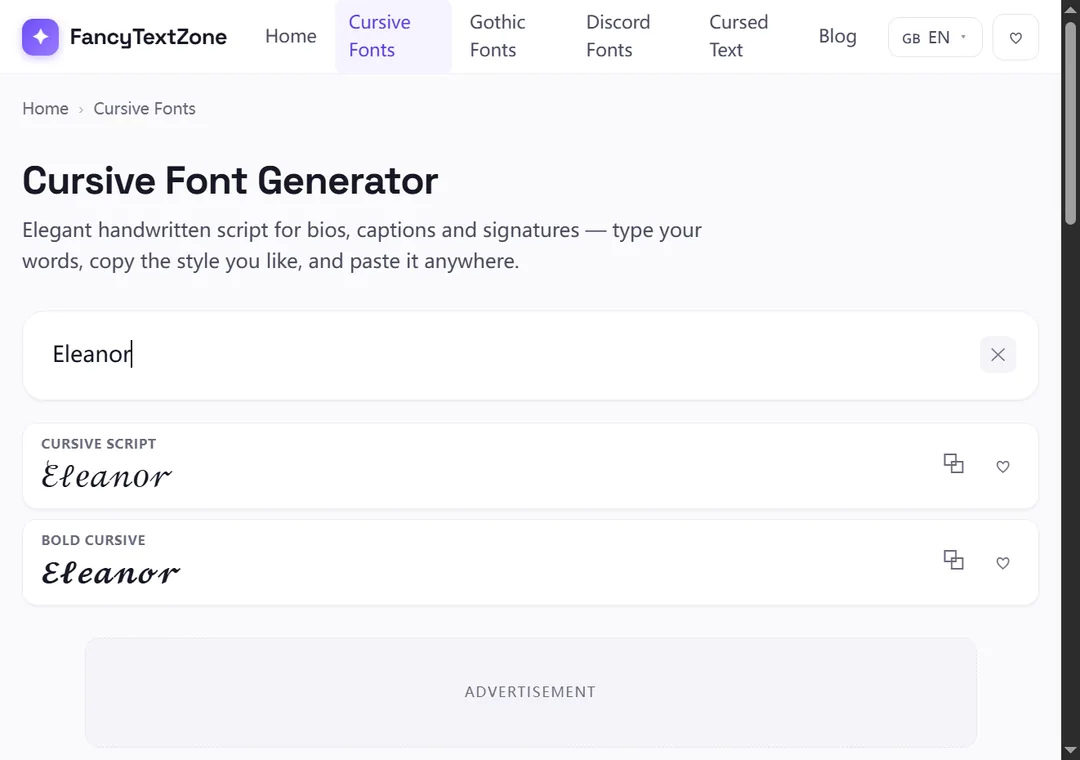
If you only remember one practical thing, make it this: among decorative styles, script travels best. The mathematical script alphabets sit in a long-established, widely shipped block, and the common system fonts on current phones and browsers include them — so they render for most people rather than collapsing into boxes. They are also complete a–z and A–Z sets (once the eleven reused letters are filled in), so every letter converts — unlike the patchy small or superscript styles.
Compare that with the combining-mark styles like cursed and zalgo, which stack characters that older renderers drop. That is why script and bold turn up again and again as the recommended choice for an Instagram bio or a display name: a lot of decorative effect for very little risk.
Reliable as it is, script still answers to the same rules as any Unicode style:
| Where you paste it | How it fares | Why |
|---|---|---|
| Instagram / social bios | Excellent | Widely supported; the usual first choice for a bio |
| Display names & nicknames | Reliable | Complete alphabet, low box risk |
| Captions, comments, messages | Fine | Accept Unicode |
| @usernames / handles | Never | Handles take plain characters only, so script never sticks |
| Search boxes & anything indexed | Avoid | Not read as plain letters, so it hurts findability |
Only the bottom row is a real catch, and it is the price of every styled set: because these are symbols rather than ordinary letters, search engines and screen readers do not treat them as the words they resemble — a point the W3C makes about using them in place of a real font. Style your name in script by all means; just keep a plain version of anything people need to search, type or hear aloud.
Open the cursive font generator, type your text, and choose the weight: the regular script for a fine, signature-like look, or the bold script for something with more presence. Tap to copy, then paste it into a bio, a name or a caption. Because the eleven reused letters are handled for you, words that contain them convert cleanly instead of leaving a stray plain letter in the middle.
A couple of pointers keep it looking right. Script's flourished capitals are beautiful but can be hard to read in long stretches, so it works best on a name or a short phrase rather than a paragraph. And although script is the most reliable style, "most reliable" is not "guaranteed", so for anything public it pays to preview it where it will actually live before you commit — more on that in the guide to boxes.
If script is your style, these guides round out the picture: the parallel story of Fraktur and blackletter, why even well-supported styles can occasionally show as boxes, and how styled text can read differently as gibberish to other people. To turn your own words into a regular or bold script, open the cursive font generator.
Those empty boxes are called "tofu". They appear when a device lacks a font for the Unicode characters behind fancy text — here is the full explanation, and how to avoid them.
That ornate "gothic" or "Old English" lettering is Fraktur, a form of blackletter with 800 years of history. Here is where it came from and how the copy-paste version really works.